

Description
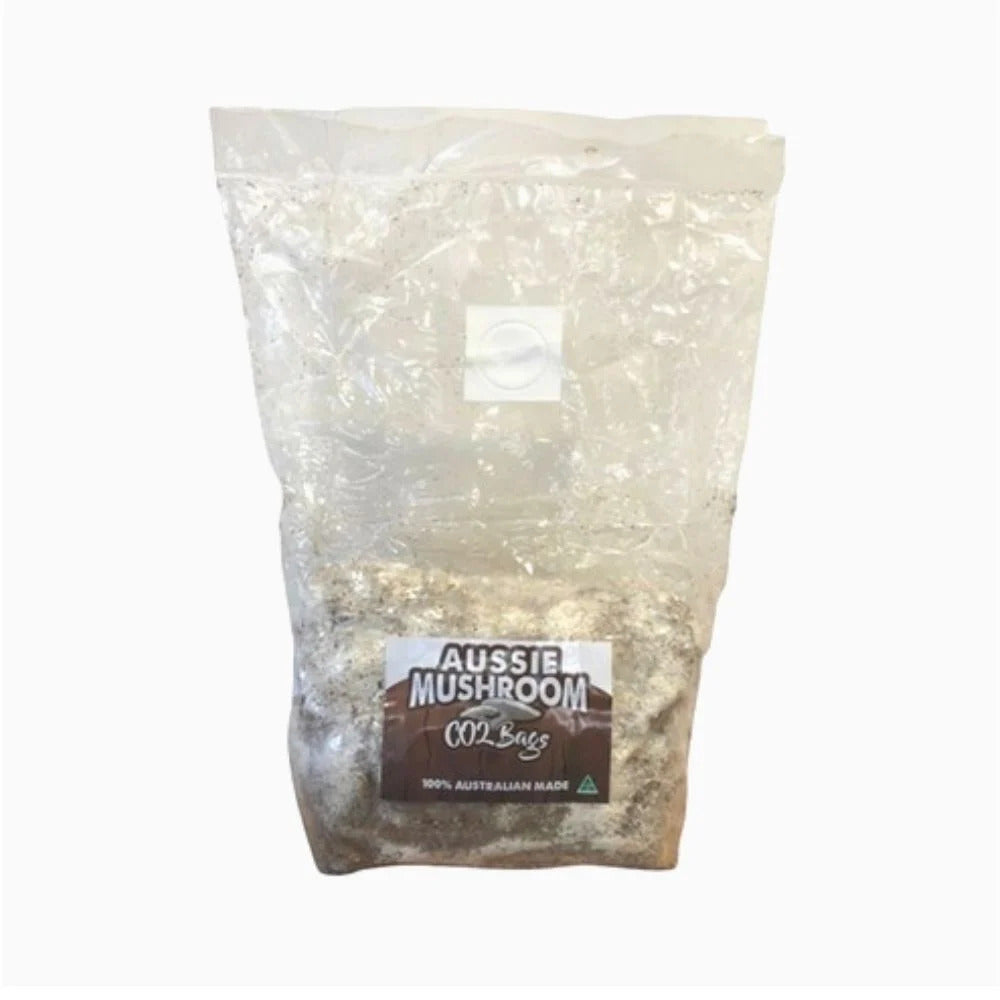
Aussie Mushroom XL CO₂ Grow Bag – Passive CO₂ Supplement for Grow Tents & Indoor Gardens
Increase carbon dioxide availability in your indoor growing environment without gas bottles, regulators, power or complicated dosing equipment with the Aussie Mushroom XL CO₂ Grow Bag.
Made in Australia using an active mushroom culture, the XL CO₂ Grow Bag naturally generates carbon dioxide as the living fungal culture metabolises the organic material inside the bag. CO₂ is gradually released into the growing environment, providing a passive, continuous source of supplemental carbon dioxide for up to approximately 6 months.
Designed for grow tents and indoor gardens, a single XL bag is suited to approximately 1–2m² of growing area, depending on ventilation, plant density and environmental conditions.
Simply position the bag appropriately within the growing environment and allow the biological process to do the work.
Key Features
- Australian-made CO₂ grow bag
- Living mushroom culture produces CO₂ naturally
- Passive, continuous CO₂ release
- Active for up to approximately 6 months
- Designed for approximately 1–2m² grow areas
- Suitable throughout vegetative and flowering stages
- No CO₂ cylinder required
- No regulator required
- No solenoid required
- No electricity required
- No refilling required
- No complicated installation
- Quiet operation
- Low maintenance
- Suitable for grow tents and indoor gardens
- Can be positioned above or below the canopy depending on ventilation configuration
- Excellent entry-level option for growers exploring supplemental CO₂
- Optional hanger can simplify positioning
Natural CO₂ from Living Mushroom Culture
The Aussie Mushroom XL CO₂ Grow Bag uses a biologically active mushroom culture rather than compressed gas or chemical CO₂ generation.
As the fungal culture continues metabolising its growing medium, carbon dioxide is naturally produced as a by-product.
The bag allows this CO₂ to gradually enter the surrounding growing environment.
This creates a straightforward biological process:
Living Mushroom Culture → Biological Activity → CO₂ Production → Passive Release into Grow Space
There are no electronics, pumps or gas regulators involved.
Why Plants Need CO₂
Carbon dioxide is one of the fundamental inputs required for photosynthesis.
Plants use:
Light + Water + Carbon Dioxide → Photosynthesis
In an enclosed indoor garden containing healthy, rapidly growing plants, CO₂ can potentially be consumed faster than it is naturally replenished.
Supplemental CO₂ can therefore be useful in appropriately managed indoor growing environments, particularly where lighting, temperature, nutrition and other environmental factors are already well controlled.
The XL CO₂ Grow Bag provides a simple way to introduce an additional passive source of carbon dioxide without immediately moving to a compressed-gas system.
Up to Approximately 6 Months of CO₂ Production
The active biological material inside the bag can continue producing CO₂ for up to approximately six months under suitable conditions.
Actual useful life can vary with:
- Temperature
- Storage history
- Age of the culture
- Environmental conditions
- Biological activity
- Ventilation
- Placement
Because this is a living biological product, output isn't controlled with the precision of a regulated bottled-CO₂ system.
For growers who need to maintain a specific CO₂ concentration, a dedicated CO₂ monitor or controller should be used to measure the actual environment.
Designed for Approximately 1–2m²
One Aussie Mushroom XL CO₂ Grow Bag is intended for approximately 1–2 square metres of growing area.
This makes it particularly well suited to common indoor growing environments such as:
- Grow tents
- Propagation areas
- Vegetative rooms
- Flowering spaces
- Indoor gardens
- Hydroponic rooms
Actual CO₂ concentration will depend heavily on the volume of the space and how quickly ventilation removes CO₂.
Ideal for Grow Tents
Grow tents are a natural application for passive CO₂ bags because they provide a defined growing environment where the bag can be positioned close to the plant canopy.
Potential applications include:
- 1m × 1m tents
- 1.2m × 1.2m tents
- Similar compact growing spaces
- Propagation tents
- Vegetative tents
- Flowering tents
Larger areas or heavily planted environments may require additional bags, but CO₂ concentration should be measured rather than simply adding bags based on guesswork.
Where Should I Put the CO₂ Bag?
Placement depends on the way air moves through your growing environment.
Sealed or Intermittently Ventilated Grow Spaces
Position the bag around or slightly above canopy level so the released CO₂ can enter the growing zone.
Because CO₂ is denser than ordinary air, circulation fans can help distribute it throughout the canopy rather than allowing it to remain concentrated in one location.
Negative-Pressure Grow Tents
In a continuously extracted grow tent, positioning the bag lower in the growing area or near the incoming airflow can allow circulation and extraction patterns to draw the released CO₂ through the plant canopy.
The objective isn't simply to hang the bag as high as possible.
The objective is to position it where the room's existing airflow carries CO₂ through the plant canopy before it reaches the extraction point.
Air Circulation Matters
A circulation fan can help distribute CO₂ throughout the growing area.
Good circulation helps prevent stagnant pockets and promotes a more uniform environment around the foliage.
The CO₂ bag therefore works particularly well alongside appropriately sized:
- Oscillating fans
- Clip-on circulation fans
- EC circulation fans
- Grow-tent fans
The fan should circulate room air rather than blast directly into the CO₂ bag at excessive speed.
Ventilation Matters Too
Passive CO₂ supplementation is most effective when the generated CO₂ remains in the growing environment long enough for plants to utilise it.
A powerful extraction fan operating continuously can remove supplemental CO₂ very quickly.
This doesn't mean ventilation should simply be switched off. Temperature, humidity and air quality still need to be managed appropriately.
Instead, CO₂ supplementation should be considered as part of the complete environmental strategy.
Suitable Throughout the Crop Cycle
The Aussie Mushroom XL CO₂ Grow Bag can remain in the growing environment throughout the major stages of plant development.
Propagation & Early Growth
Young plants generally have relatively modest CO₂ demand, but the bag can remain operating passively as the growing environment develops.
Vegetative Growth
As leaf area increases, plants develop greater photosynthetic capacity and demand for environmental resources.
Flowering & Fruiting
The bag can continue producing CO₂ through the flowering phase, provided the biological culture remains active.
There is no need to switch the bag between separate vegetative and flowering operating modes.
No CO₂ Cylinder Required
Traditional controlled CO₂ supplementation can require:
- Compressed CO₂ cylinder
- Gas regulator
- Solenoid
- CO₂ controller
- Tubing
- Distribution equipment
- Refilling or cylinder exchange
A mushroom CO₂ bag eliminates this equipment requirement.
Simply position the active bag in the growing environment and allow it to operate passively.
No Electricity Required
The biological process that generates the CO₂ requires no electrical power.
That means:
- No additional electrical outlet
- No electrical timer
- No pump
- No controller required for basic operation
- No additional power consumption
A separate CO₂ monitor can still be used if you want to measure the actual concentration in the grow space.
Passive CO₂ Bag vs Bottled CO₂
The two approaches serve different requirements.
| Feature | Aussie Mushroom XL CO₂ Bag | Bottled CO₂ System |
|---|---|---|
| CO₂ Source | Living mushroom culture | Compressed gas |
| Electricity Required | No | Usually controller/solenoid |
| Regulator Required | No | Yes |
| Gas Bottle Required | No | Yes |
| Refilling | No | Yes |
| Installation | Very Simple | More complex |
| CO₂ Output | Passive | Controlled |
| Precise PPM Control | No | Possible |
| Initial Equipment Cost | Lower | Higher |
| Maintenance | Minimal | More involved |
| Best Application | Small/medium personal grows | Controlled high-demand environments |
The mushroom bag is particularly attractive to growers who want simple passive supplementation rather than precision CO₂ injection.
CO₂ Bag vs CO₂ Bottle – An Important Difference
A passive CO₂ bag shouldn't be marketed as though it provides the same degree of control as bottled CO₂.
A regulated system can actively inject gas to maintain a selected concentration when connected to suitable monitoring equipment.
A mushroom bag produces CO₂ biologically, meaning its output naturally varies.
For this reason, the XL bag is best viewed as:
Passive CO₂ supplementation
rather than:
Precision CO₂ dosing
This distinction helps growers choose the appropriate solution for their environment.
How to Use
Step 1 – Position the Bag
Place or hang the bag in the growing area according to the room's airflow pattern.
Step 2 – Follow the Activation Instructions
Prepare the product exactly as directed on the supplied packaging.
Do not unnecessarily open or disturb the active growing medium inside the bag.
Step 3 – Maintain Air Circulation
Use normal grow-room circulation to help move released CO₂ throughout the canopy.
Step 4 – Manage Extraction
Remember that continuously exhausting room air also removes supplemental CO₂.
Balance ventilation with temperature and humidity requirements.
Step 5 – Monitor Where Required
For growers wanting to understand the actual effect of supplementation, use a suitable CO₂ meter.
Step 6 – Replace When Production Declines
The bag can remain biologically active for up to approximately six months. Replace it when its useful CO₂ production has substantially declined.
Don't Open the Grow Bag
The active mushroom culture is intended to remain contained.
Avoid cutting open, emptying, squeezing or otherwise unnecessarily disturbing the bag during normal use.
The controlled bag environment supports the living culture while allowing gaseous exchange.
Opening it can disrupt the internal environment and introduce contamination.
Fresh Australian Production Matters
CO₂ mushroom bags are living biological products.
This makes freshness more relevant than it would be for an ordinary piece of grow-room equipment.
An Australian-produced bag can spend less time travelling through international supply chains before reaching the grower compared with imported living CO₂ products.
That makes locally produced bags particularly attractive when the objective is to maximise the useful biological life available after purchase.
Product Specifications
| Specification | Details |
|---|---|
| Product | Aussie Mushroom XL CO₂ Grow Bag |
| Product Type | Passive CO₂ Supplement |
| CO₂ Source | Living Mushroom Culture |
| Size | XL |
| Active Period | Up to approx. 6 months |
| Recommended Grow Area | Approx. 1–2m² per bag |
| Electricity Required | No |
| CO₂ Cylinder Required | No |
| Regulator Required | No |
| Refilling Required | No |
| Maintenance | Minimal |
| Application | Indoor Growing / Grow Tents |
| Growth Stages | Propagation, Vegetative & Flowering |
| Country of Production | Australia |
| Installation | Hang or Position in Grow Space |
Why Choose the Aussie Mushroom XL CO₂ Grow Bag?
The Aussie Mushroom XL CO₂ Grow Bag offers one of the simplest ways to introduce supplemental carbon dioxide into an indoor growing environment.
There are no heavy cylinders to exchange, no regulators to adjust and no electronic dosing system to configure.
Instead, an active mushroom culture naturally generates CO₂ and gradually releases it into the grow space.
Its up-to-six-month active life, approximately 1–2m² recommended coverage and completely passive operation make it particularly attractive for grow tents and personal indoor gardens where a complete bottled-CO₂ installation would be unnecessarily complicated.
And because the product is Australian produced, growers receive a locally sourced living product rather than relying entirely on imported biological CO₂ bags that may have already spent significant time in international transit.
Frequently Asked Questions
What is an Aussie Mushroom XL CO₂ Grow Bag?
It is a passive CO₂ supplementation product containing an active mushroom culture that naturally produces carbon dioxide through biological activity.
How long does it last?
The XL bag can remain productive for up to approximately six months, depending on environmental conditions and biological activity.
How much area does one bag cover?
One XL bag is recommended for approximately 1–2m² of growing area.
Does it need electricity?
No. CO₂ production is biological and requires no electrical power.
Do I need a CO₂ bottle?
No.
Does it need a regulator?
No. There is no compressed gas cylinder to regulate.
Do I need to refill it?
No. Once its useful biological life is exhausted, the bag is replaced rather than refilled.
Is it made in Australia?
Yes. The Aussie Mushroom XL CO₂ Grow Bag is an Australian-produced product.
Can I use it in a grow tent?
Yes. Grow tents and similar indoor gardens are primary applications.
Should I hang it above my plants?
In sealed or intermittently ventilated spaces, positioning it around or slightly above the canopy can work well. In continuously extracted negative-pressure environments, lower placement near incoming airflow may sometimes provide better movement through the canopy.
Does CO₂ automatically sink onto the plants?
CO₂ is denser than ordinary air, but real grow rooms have significant air movement and mixing. Don't rely solely on CO₂ "falling" onto plants. Good circulation and thoughtful placement are more important.
Can I use a circulation fan with it?
Yes. Appropriate air circulation can help distribute CO₂ throughout the growing environment.
Will my extraction fan remove the CO₂?
Yes. Exhaust ventilation removes room air, including supplemental CO₂. This is why passive supplementation is generally more effective where air isn't being completely exchanged at a very high continuous rate.
Can I use it during flowering?
Yes. The bag can remain in use during both vegetative and flowering growth.
Can I precisely control CO₂ ppm with the bag?
No. Biological CO₂ output varies naturally. If maintaining a specific CO₂ concentration is important, use a CO₂ monitor and consider an actively controlled supplementation system.
Should I open the bag?
No. Don't cut open or empty the active bag during use. Follow the supplied activation and positioning instructions.
How do I know whether it's actually increasing CO₂?
The reliable way to determine the concentration in your particular growing environment is with a CO₂ meter or environmental controller equipped with CO₂ sensing.